Tree Tour
Biological, Geological and Environmental Sciences
Campus Location:
Science Building (SI)
2399 Euclid Avenue, Rm. 219
Cleveland, Ohio 44115
Contact Us:
Phone: 216.687.2440
Fax: 216.687.6972
bges@csuohio.edu
Tulip Tree
(Liriodendron tulipifera)
Family: Magnoliaceae
Phylum: Anthophyta
CSU Tree Map Item #7
Distribution
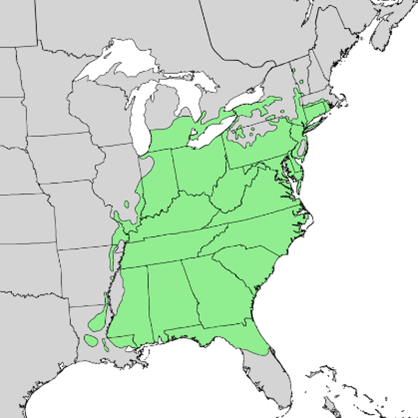
By U.S. Geological Survey & Elbert L. Little, Jr., of the U.S. Department of Agriculture, Forest Service - USGS Geosciences and Environmental Change Science Center: Digital Representations of Tree Species Range Maps from: Elbert L. Little, Jr. (1971), Atlas of United States trees, Vol. 1, conifers and important hardwoods: U.S. Department of Agriculture Miscellaneous Publication 1146, 9 p., 200 maps., Public Domain, https://commons.wikimedia.org/w/index.php?curid=22089395
Leaves
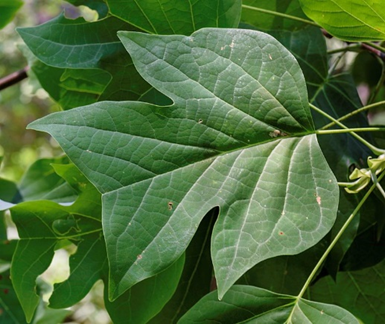
By PumpkinSky - Own work, CC BY-SA 4.0, https://commons.wikimedia.org/w/index.php?curid=61414496
Flowering
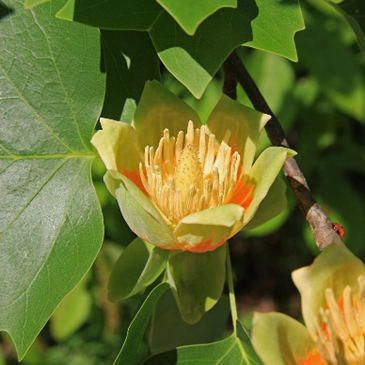
By Dcrjsr - Own work, CC BY 3.0, https://commons.wikimedia.org/w/index.php?curid=19112108
Fruit
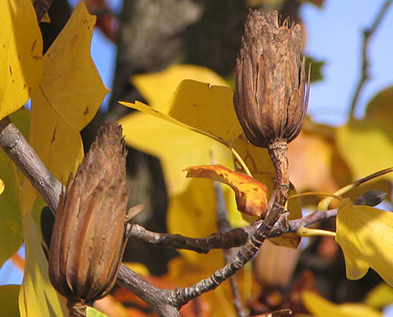
By The original uploader was Gmihail at Serbian Wikipedia. - Transferred from sr.wikipedia to Commons by Micki using CommonsHelper., CC BY-SA 3.0 rs, https://commons.wikimedia.org/w/index.php?curid=19681573
Questions
Using the bark descriptors given in the handout, describe the type of bark this tree has.
Look at the flowers (either on the tree or in the photos) – what features do the flowers have that let you know this species belongs in the family Magnoliaceae?
If it’s related to Magnolias, why did it get named “tulip” tree?
Biological, Geological and Environmental Sciences
Campus Location:
Science Building (SI)
2399 Euclid Avenue, Rm. 219
Cleveland, Ohio 44115
Contact Us:
Phone: 216.687.2440
Fax: 216.687.6972
bges@csuohio.edu