Tree Tour
Biological, Geological and Environmental Sciences
Campus Location:
Science Building (SI)
2399 Euclid Avenue, Rm. 219
Cleveland, Ohio 44115
Contact Us:
Phone: 216.687.2440
Fax: 216.687.6972
bges@csuohio.edu
American Elm
(Ulmus americana)
Family: Ulmaceae
Phylum: Anthophyta
CSU Tree Map Item #28
Distribution
Ulmus americana is a species native to eastern North America, naturally occurring from Nova Scotia west to Alberta and Montana, and south to Florida and central Texas. The American elm is an extremely hardy tree that can withstand winter temperatures as low as −42 °C (−44 °F). Trees in areas unaffected by Dutch elm disease (DED) can live for several hundred years.
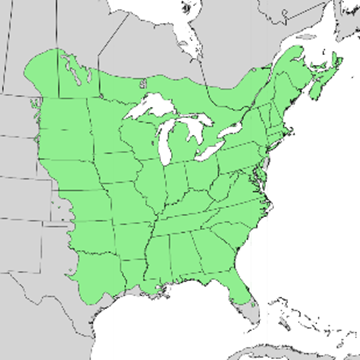
By U.S. Geological Survey - Digital representation of "Atlas of United States Trees" by Elbert L. Little, Jr. [1], Public Domain, https://commons.wikimedia.org/w/index.php?curid=12786718
Leaves
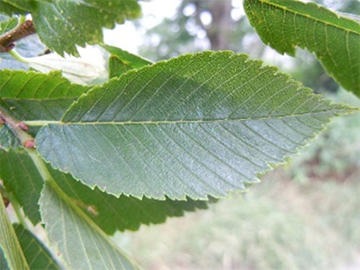
By Matt Lavin from Bozeman, Montana, USA - Ulmus americanaUploaded by Tim1357, CC BY-SA 2.0, https://commons.wikimedia.org/w/index.php?curid=22758150
Flowering
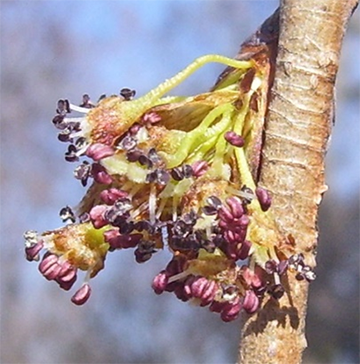
Source: https://www.nrs.fs.fed.us/fmg/nfmg/bl_hardwood/eco/spechar/elm_amer.html
Seeds
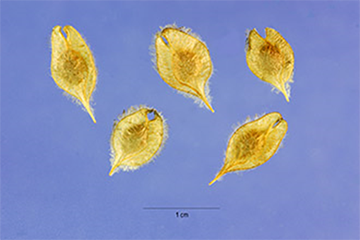
By Steve Hurst, hosted by the USDA-NRCS PLANTS Database
Questions
Using the bark descriptors given in the handout, describe the type of bark this tree has.
How are the leaves of the elm similar to leaves of #22, the Alleghany serviceberry? How are they different?
Biological, Geological and Environmental Sciences
Campus Location:
Science Building (SI)
2399 Euclid Avenue, Rm. 219
Cleveland, Ohio 44115
Contact Us:
Phone: 216.687.2440
Fax: 216.687.6972
bges@csuohio.edu