Thirty Years of Culture, Community and Connection at Cleveland State University
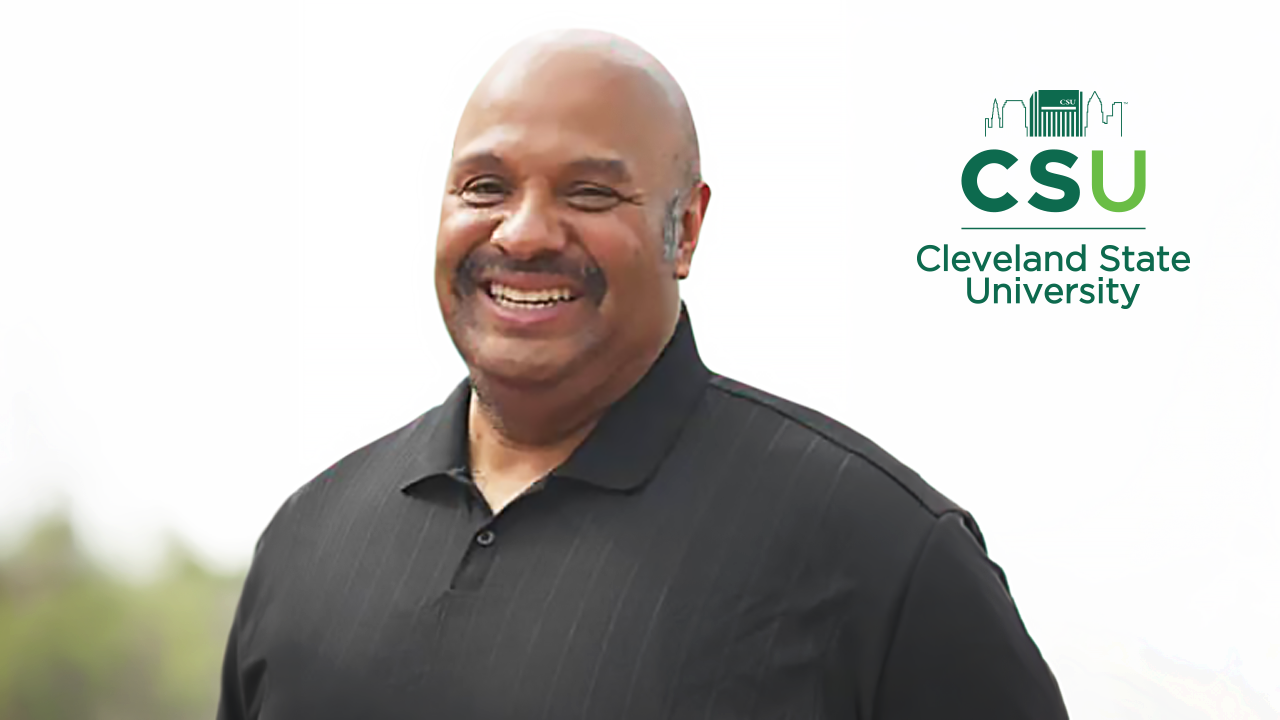
For three decades, Prester Pickett, coordinator of the Howard A. Mims African American Cultural Center (HAMAACC), has helped shape the cultural heartbeat of CSU through programming, mentorship and a deep commitment to community-centered storytelling.
He recently celebrated his 30th anniversary at the university and reflected on his first moments on CSU’s campus in 1996.
“It was very exciting,” Pickett said of his first days at CSU. “I was greeted with an enlarged Plain Dealer article written about me. It was an acknowledgment that someone was paying attention to the work I was doing.”
Welcomed by A. Grace Lee Mims and a close-knit network of Black scholars, Pickett quickly recognized that his role extended beyond program coordination to fostering meaningful connections and building bridges across communities.
Building a Cultural Legacy
Throughout his tenure, Pickett has led several signature initiatives that have become staples of campus life, including the Kwanzaa-inspired Kuumba Arts Festival, which showcased local artists and provided students opportunities to perform alongside them.
“The excitement in knowing that out of those performances, a number of our students went on to acquire doctoral and master’s degrees—that’s meaningful,” said Pickett. “I'm proud of the fact that many of the programs we started were lifted and advanced and grew into other organizations [and] students organizations started to understand the significance of cultural celebrations.”
With the Black Studies program not yet established as the Department of Africana Studies during the Kuumba Arts Festival years, Pickett focused on engaging the broader student community through what he calls “edutainment,” creating spaces where fashion shows, film screenings, line dancing and poetry collectives fostered both creativity and scholarship.
“Through the Kuumba Arts Festival, we also had a tribute to Silver Bee with the Silver Bee Award that was given to an artist or an artistic entity on an annual basis who understood the concept of edutainment,” said Pickett. “They understood how important it was to connect education and entertainment and blend them particularly on reaching a community that had been distanced for various reasons from college campuses and definitely with Cleveland State being one of the campuses.”
These efforts not only enriched campus life but also extended CSU’s reach into the broader community. Pickett also emphasized the importance of HAMAACC, which he helped establish at CSU.
“We were building bridges that would allow the community to send us students,” he said. “The cultural center became a recruitment vehicle.”
The center, formerly known as the Afro-American Cultural Center, was established in 1970 and renamed in 2004 to honor the legacy of Dr. Mims, who served as director from 1991 to 2001.
Through partnerships with organizations such as the NAACP's ACT-SO program, Pickett helped bring students from across the greater Cleveland community to campus, exposing them to opportunities in academics, the arts and technology. Many of those students later enrolled at CSU, continuing the center's impact on future generations.
“In fact, the choreopoem that I recently produced at the Midtown Collaboration Center allowed me to make a connection to some of my former students who participated and were ACT-SO students,” said Pickett. “They're all grown now.”
He emphasized the importance of building a community of individuals who not only attend CSU, but also continue to engage with its programs.
Learning Beyond the Classroom
Pickett’s impact extended beyond campus through educational trips that connected classroom learning with history.
Students participated in the Soul of Cleveland tour, visited Cincinnati’s National Underground Railroad Freedom Center—where activist Joan Southgate joined them—and traveled to Niagara Falls to explore its historical significance. Students also visited an African American museum featuring an immersive exhibit that recreates the conditions endured by enslaved people during the Middle Passage.
“It usually brings people to tears,” he said. “[I’ve enjoyed] hearing what's on [students] minds and hearing how they interpreted experiences. That joy I've had for 30 years.”
The HAMAACC: A Space for Belonging
At the center of Pickett’s work is a simple yet powerful idea: Students need space, both physically and emotionally, to be seen and heard.
Over the years, HAMAACC has served as a hub for healing, dialogue and connection during both moments of celebration and times of hardship — from national tragedies to local losses. Even as the cultural center has relocated and evolved, its purpose remains the same. For many students, including those who discovered it by chance, the space has had a lasting impact.
“We have a space that helps our community heal,” said Pickett. “We have a space that allows people to talk out their concerns and be civil about what they might decide to do as they grow into greater maturity.”
Lasting Impact: A Legacy That Endures
Pickett’s impact extends beyond programs and events; his mentorship has shaped generations of students who have become scholars, artists and leaders, and he has also helped bridge the campus and the broader Cleveland community by connecting students with local institutions and history.
“Karamu House would come and bring their actors and we would put on scenes in the student center,” he said. “As a result, we started to connect our students with the institutions around the city,” he said.
He emphasized the importance of helping students understand the cultural richness around them and called for intentional programming that fosters lasting connection and dialogue.
“Our students don't know that East Cleveland was the mecca for Black life,” he said, highlighting how programming encouraged students to explore nearby spaces through resources like public transit and visits to landmarks such as the Martin Luther King Jr. library and Wade Oval. “It's important to have activities that engage our students,” he said referencing film screenings and discussions that tackled real-world issues.
Pickett hopes to expand those experiences by bringing influential voices to campus.
“What I’m still trying to do now for the future is to get Spike Lee to come back and talk about some of his works and allow our film and media arts students to pay attention to him.”
Looking Ahead
Pickett’s 30-year milestone is not just a reflection of longevity; it is a testament to sustained impact. His work has helped position Cleveland State as a place where culture is not an accessory to education but a vital part of it. He credited much of this vision to the legacy of Mims.
“There are a number of individuals that we are connected to because of the legacy of Dr. Howard Mims and how he kept those connections,” said Pickett.
As Pickett looks to the future, he envisions reconnecting with alumni and reigniting large-scale cultural programming that brings together past and present Vikings.
“For me, I would love to have a reunion of individuals who have advanced their lives and careers and are so connected,” he said. “That vibrancy of engagement is still possible, and we can revive that.”
Through every lecture, performance, trip and conversation, Pickett has reinforced a central truth: when students feel connected to culture and community, they thrive.
After 30 years, that mission continues.
Pickett was also a guest on Cleveland State University’s official podcast, Viking Voices.