Fenn Tower Through Time: The Story of CSU’s Enduring Landmark
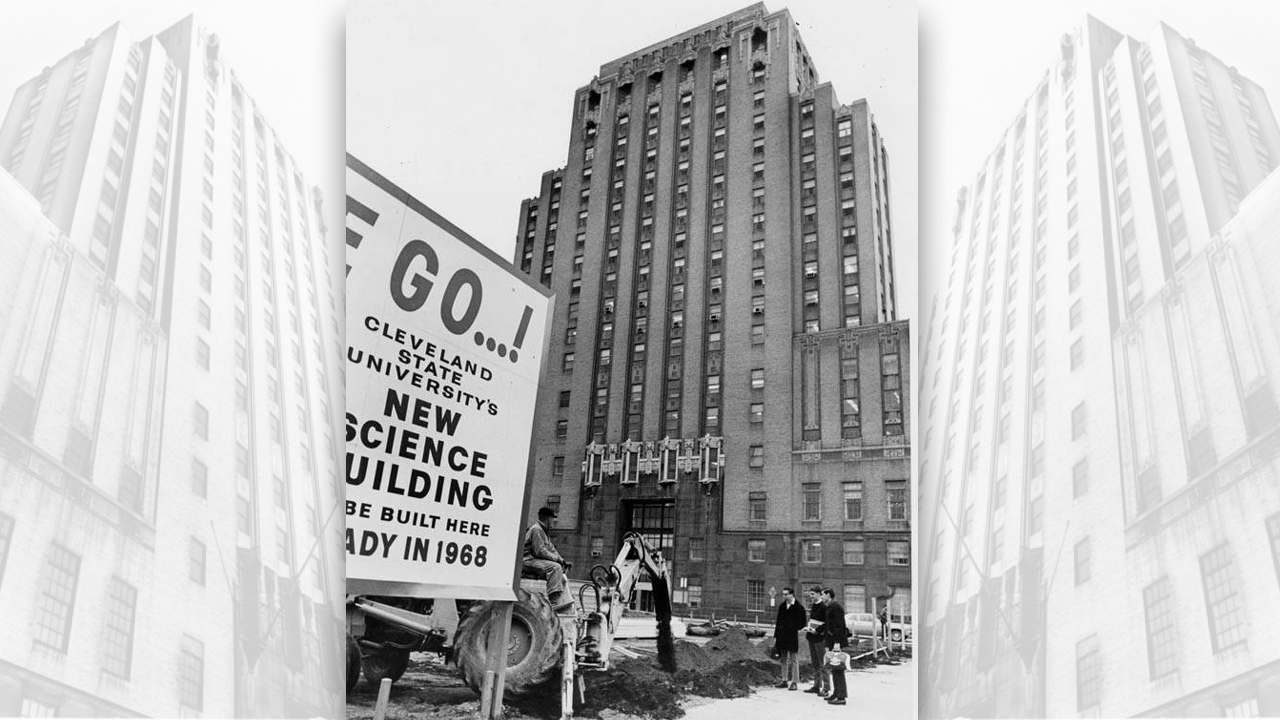
A notable landmark at Cleveland State University is set to return in time for the fall semester.
Fenn Tower has evolved alongside the history of CSU, whose roots date back to 1870, when the Cleveland YMCA first offered free evening classes. The YMCA needed accreditation to recognize its educational program in 1930 and was later renamed Fenn College after YMCA leader Sereno Peck Fenn.
Fenn College continued to expand, providing affordable, high-quality education, and became the second institution in Ohio, after the University of Cincinnati, to implement a cooperative education program. Students were offered paid opportunities while earning their education.
As Fenn Tower continued taking shape long before serving as student housing, it also reflected a different era of Cleveland. It was a period shaped by luxury, ambition and change.
“The building that became known as Fenn Tower was originally built for the National Town and Country Club in 1929,” explained Mark Souther, CSU history professor and local historian. “This was a prominent men’s club.”
The multipurpose space catered to the social and recreational needs of its members.
“They had six bowling alleys in the basement and a solarium on the top floor, three dining rooms, a swimming pool and a gymnasium,” said Souther.
But the club’s original purpose was short-lived. Constructed on the eve of the Great Depression, the building’s grand vision quickly unraveled.
“They built this lavish building on Euclid Avenue and never really moved into it,” said Souther. “There was a Christmas luncheon in 1929. That was both the first and the last event held in the building.”
Financial collapse plunged the building into uncertainty almost immediately after its opening. Souther said the owners were deeply in debt and ultimately were forced to sell the building.
A Tower Continues to Transform
The 22-story tower remained vacant until 1937, when it was acquired by Fenn College.
The former club was transformed into a hub for classrooms and offices and renamed Fenn Tower. Often called the “Skyscraper Schoolhouse,” the re-envisioned building housed classrooms, a library, a gymnasium, a pool, student lounges and other amenities that supported student life.
“It’s important to think about how buildings have to evolve,” said Souther. “Fenn Tower is a great example of that.”
After World War II, Fenn Tower entered another period of change as enrollment surged under the GI Bill, prompting the college to use nearby Quonset huts from the military for additional classroom and campus space. During the 1940s, the tower also continued to take on new roles. Its basement was converted into electrical engineering laboratories, and around this time, the building earned the nickname “Campus in the Clouds.”
During his 1962 campaign for governor, James A. Rhodes promoted the idea that every Ohioan should live within 30 miles of a state university. At the time, Kent State University was the nearest state institution serving Cleveland. On Dec. 18, 1964, Rhodes signed legislation that officially created CSU as Ohio’s seventh state university.
Fenn Tower served multiple roles over time, including classrooms, offices and student services such as registration and health care, before becoming one of CSU’s most iconic landmarks.
Dorm use continued from 1967 to 1986, when Viking Hall opened to replace Fenn Tower as a residence hall. "I also found mention of the intent as early as 1965 to make Fenn Tower more residential and recreational in focus," said Souther. "But it took some time to effect that, largely by creating the so-called "Instant Campus" in pre-fab buildings used as classrooms."
Souther also remarked that its survival represents a story of endurance and transformation.
“I'm sure in the 1930s after the club went bankrupt, people looked at that building and wondered if this building would be torn down or would it find another use,” said Souther. “It survived the challenge.”
Throughout the 2000s, the building faced another challenge under the administration of Michael Schwartz, when university leaders debated whether the structure still had a future on campus or should be demolished. However, tearing the building down would have come at a significant cost.
“I think they rightly looked at it and saw that it would be a loss to get rid of a building that, if repurposed, would have new life. It would fit into the mission of becoming a residential campus,” said Souther.
In 2006, the building that once served commuter students was transformed into a residence hall, marking a major step in developing a residential campus community at CSU.
Souther also noted that Fenn Tower stands on what was once part of Cleveland’s historic Millionaire’s Row, where mansions lined the street before one was demolished to make way for the tower.
“It's also kind of interesting that it used to be part of Millionaire's Row. You could imagine that before Fenn Tower and before CSU there were mansions there,” he said. “That was actually a mansion right there. It got torn down to build Fenn Tower. Luckily Fenn Tower stayed.”
Souther noted that Rufus Winslow, a North Carolina native born in 1831, eventually made his way to Cleveland and occupied the mansion on Millionaire’s Row. Winslow was a shipping magnate who operated a fleet of ships on the Great Lakes. He built his Victorian-style mansion in 1878, where it stood until it was demolished to make way for the tower.
Architecture and Craftsmanship that Reflects Global Influence
Fenn Tower stands out not only for its history but also for its distinctive design. The building incorporates stylized classical forms with Egyptian and Mayan influences throughout. The tower was designed by architect George B. Post, known for landmarks such as the New York Stock Exchange Building and the Cleveland Trust Company Building.
“It has really unique Art Deco features, which are nice for students to be introduced to,” said Souther. “You’ve got this American architectural style that also evokes other cultures such as that of the Maya in Mesoamerica, but is then using materials from East Africa,” he said. “It’s multicultural, a really interesting combination of things.”
Those details connect students to a broader architectural and cultural history that predates CSU itself.
A Legacy That Endures
As Fenn Tower prepares for its next chapter as a modernized residence hall, its history remains embedded within its walls. That history is more than a backdrop. It is part of the experience itself, shaping how each new generation of students understands where they live, learn and grow.
For Souther, the hope is that students not only live in the building but also understand the story beneath it.
“It’s a combination of preserving the historical essence of the building’s origin while making it entirely functional in the 21st century.”
That continuity, he added, strengthens the building’s value to both the university and the city.
“That building isn’t going down without a fight.”