Annual Columbus Seminar Brings State Government to Life for CSU Students
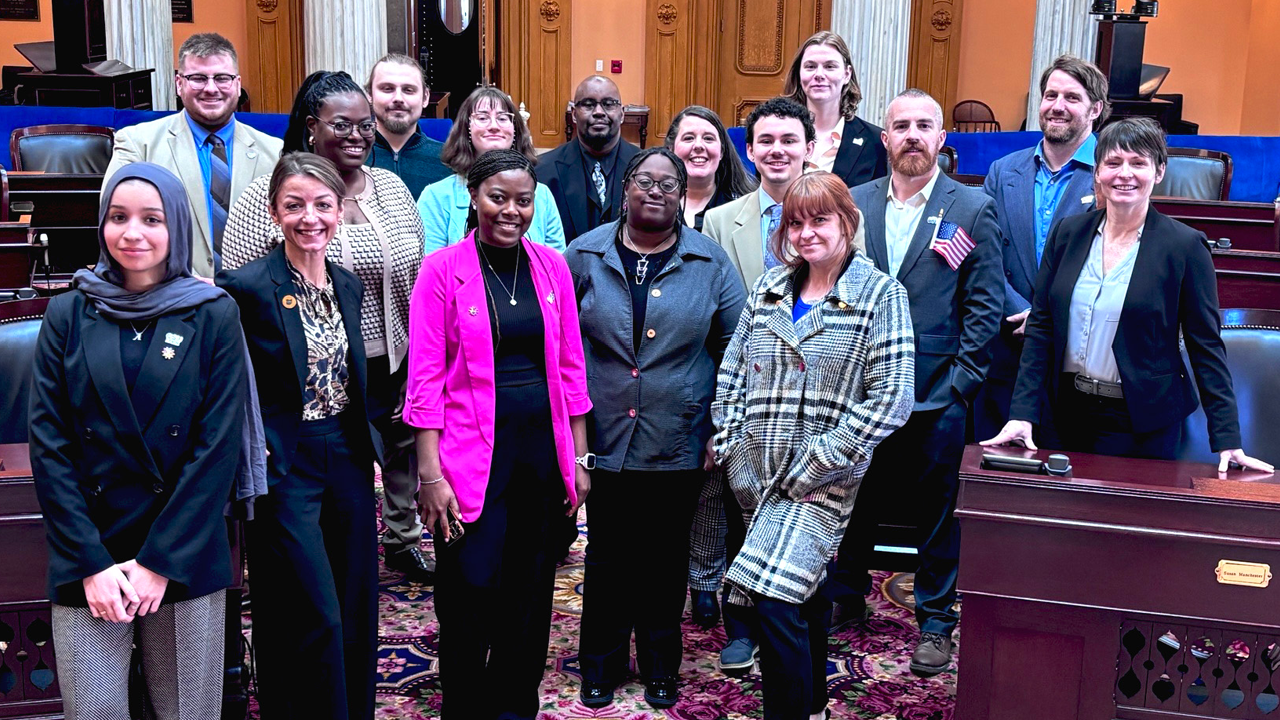
At Cleveland State University, students aren’t just learning how government works — they’re stepping directly into it.
The annual Levin College of Public Affairs and Education Columbus Seminar is a longstanding program that provides students with a week of hands-on experience in public service at the local, county and state levels, immersing them in Ohio’s policymaking process through meetings with legislators, engagement with agencies and advocacy groups and firsthand exposure to the pace and pressure of the Statehouse.
“The seminar offers students an opportunity to be exposed to state government and the state legislature in a way that they would not otherwise be exposed to,” said Caryn Candisky, executive director of government affairs and special assistance at CSU. “In their classes, they study what happens in Columbus, but there really is no better way to learn about these issues in our government than experiencing it firsthand.”
Meghan Rubado, associate professor in the Maxine Goodman Levin School of Urban Affairs, leads the course and said what sets the seminar apart from a traditional classroom experience is students’ direct access to current public servants in state government.
“Students get to see the ins and outs of the job,” said Rubado. “When you think about what a legislator does and what their workday entails, it might sound to an outsider like something glamorous, but the work on the ground is challenging. The legislators are hustling. They have incredibly stretched schedules. The students get attached to that. From early mornings to packed evenings, the students' schedules mirror real life at the Statehouse.”
Rubado also said the seminar offers a clear difference between reading about government and seeing it firsthand, allowing students to experience it in a way that helps them imagine themselves in these roles.
Learning Through Experience
This year’s cohort included 15 students and began with a Statehouse tour led by Dan Shellenbarger of Ohio Public Media, followed by orientation, a seminar alumni panel and a bill simulation discussion.
Guest alumni included Jacob Bell, Graciana Flajnik and Corey Schaal.
Over the next several days, students participated in planning sessions, policy briefings, and meetings with public officials and organizations, including the Ohio Attorney General’s Office, the Ohio Arts Council, the Office of Budget and Management, and House Republican and Democratic caucus staff, and the nonpartisan Legislative Service Commission (LSC).
Programming included a news media panel and discussions on ethics, lobbying and think tanks, along with legislator shadowing, the State of the State address, and sessions on higher education, Medicaid and local government advocacy. The seminar concluded with an Ohio Supreme Court tour, a final bill simulation in the Senate chamber, and a meeting with Giles Allen and Gretchen Craycraft, who are senior legislative officials in Governor DeWine’s office.
Craycraft completed the Columbus Seminar during her graduate studies at CSU.
Kat Hollo, a graduate student and assistant director at the Levin College Center for Public and Nonprofit Management, said the seminar reinforced the value of hands-on learning and student connections.
“I have never learned so much in a five-day period,” she said. “It was exhausting — but it was so worth it. The impact the seminar had on me personally was huge. The amount of information we got and the amount of exposure, we have so many people's contacts. I even had a representative send me a message on LinkedIn the other day saying, ‘thanks for visiting.’”
Going into the trip, Hollo said she had “blind spots” about how government works, but her perspective shifted by the end.
“The seminar was inspiring and made me feel a lot more comfortable,” said Hollo. “I left that trip with less anxiety about what is going on in our country. The people that I spoke to are really working for the constituents of Ohio. I felt much safer. I felt like, okay there are people fighting for us.”
Immersive Learning in Action
The week culminated in a legislative simulation on the Ohio Senate floor, where students debated a bill in an experience that brought classroom concepts to life after preparing in advance by studying Ohio government and researching active legislation.
“Each student selected a bill to study that was under consideration in the General Assembly; they tracked the bill,” said Rubado. “They researched the different proponents and opponents of the bill. They researched the sponsor, co-sponsors and what problem the bill was trying to mitigate or solve.”
On the final morning of the seminar, students engaged in a bill simulation exercise in the Senate chamber at the Statehouse.
Courtney McDonald, undergraduate and accelerated MPA student, served as Senate president during the bill simulation exercise and said the seminar offered a comprehensive, real-world look at government.
“I approached my bill as if I were to focus on small-town rural communities and how they would want to approach this situation,” said McDonald. “What’s the best way to put them in the best position? I felt good about the decisions that I made because I had time to logically think about them.”
She also noted her approach during the seminar after she learned she would serve as Senate president.
“We found out what our roles were once we got to the seminar,” said McDonald. “Throughout the week, I watched videos to study how Senate presidents, current and in the past, run their chamber sessions. I studied what I could do, how I could present myself. It was fun.”
Seminar Alum Speaks on a Week That Changes Lives
For many students, the seminar became more than a class; it became a turning point.
“That is what happened to Senator Nickie Antonio,” said Rubado. “She was a student in this class receiving her MPA degree in 1991. Attending the seminar was the moment she pictured herself doing this work [and] it ended up driving a career goal for her.”
Senator Antonio serves as the Democratic leader in the Ohio General Assembly, a key leadership role in which she guides her party’s legislative agenda and represents Democratic priorities across the state.
“The Columbus Seminar definitely showed me the possibility of being a policymaker,” said Senator Antonio. “I loved seeing everyone in this year’s seminar; thanks to all at CSU who continue to make this wonderful program possible!”
Amanda Shaffer, a political science senior and 2025 seminar alum, recently applied to the Ohio LSC Fellowship Program, where participants are assigned to work with members of the House of Representatives, 10 with members of the Senate, two with LSC and two with The Ohio Channel.
“The highlight of the itinerary was when we got to visit [the LSC] office and hear from the people who work there and the people who do the recruiting and the application,” said Shaffer.
Attending the seminar encouraged Shaffer to apply for the fellowship and further pursue her interests.
“I knew that I wouldn't be able to apply for another year, but being able to meet the people who go through applications was pretty comforting,” said Shaffer. “You kind of get a feel for their personalities."
Other alumni echoed the seminar’s life-changing impact.
“To this day and two degrees later, the Columbus Seminar was the most impactful class of my academic career,” said Elizabeth Kravanya, advisor and program coordinator for the Jack, Joseph, and Morton Mandel Continuing Scholars in the Honors College at CSU. “Professor Rubado really designed a great program.”
A Lasting Impact
While the schedule was demanding, the impact is enduring, and for many, the Columbus Seminar not only reshapes how they see government but also their place within it.
“It’s almost conversational; students take control of their own learning, and that’s what leads to meaningful outcomes,” said Rubabo.
“It’s a journey [and] they learn not just how the system works, but how they can make a difference within it.”